
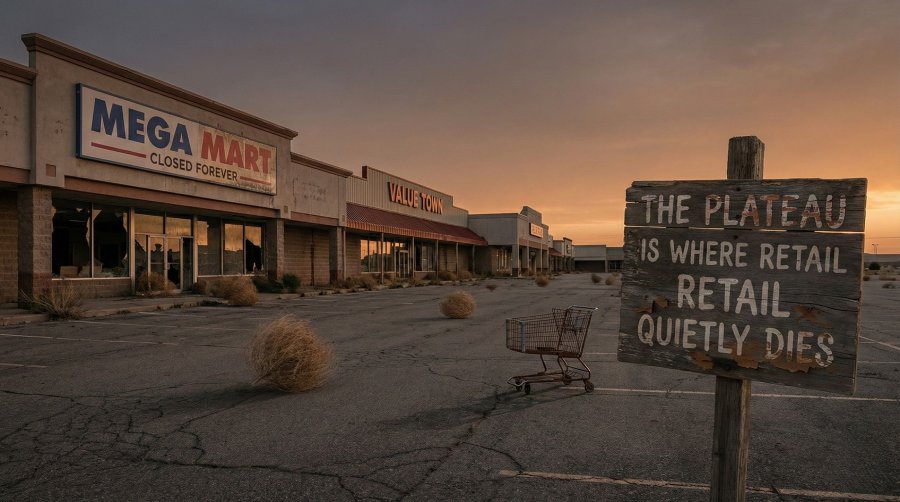
The Plateau Is Where Retail Quietly Dies
Retail leaders tend to obsess over acquisition metrics — traffic, customer acquisition cost (CAC), conversion rates, and top-of-funnel expansion. These numbers dominate dashboards and boardroom conversations. But retail businesses rarely collapse because of weakness at the top of the funnel. They collapse in the middle. They collapse in the quiet space where customers do not dramatically churn, but instead begin to stall.
Most customers do not disappear overnight. They buy once, maybe twice, and then gradually slow down. They skip a purchase cycle. They stop opening emails. They engage less frequently. Because the decline is subtle rather than dramatic, it rarely triggers urgency. Revenue continues to flow. New customers continue to enter the funnel. Dashboards remain green.
Yet something structural has shifted. The retention curve has flattened. And when retention flattens, the future shrinks.
The Plateau Is a Lifecycle Failure
The plateau is often misdiagnosed as a marketing issue, a creative issue, or a campaign issue. In reality, it is a lifecycle design failure. After a customer’s first purchase, progression should feel inevitable. Instead, most brands default to a generic thank-you email, followed by broad promotional messaging and inclusion in a mass campaign calendar. That is not progression — it is noise.
The most valuable moment in retail is not the first transaction. It is the transition from purchase one to purchase two. That is the inflection point that determines whether lifetime value will compound. The probability that a customer becomes high lifetime value increases significantly after the second purchase. When customers are lost between purchase one and purchase two, the issue is rarely weak demand. It is weak onboarding.
Unfortunately, retail onboarding is often accidental rather than engineered. There is no structured journey, no timed reinforcement, no behavioral triggers, no category education, and no intentional identity formation. There are emails — and hope.
Hope is not a growth strategy.
Promotions Create the Illusion of Retention
Many retailers become addicted to promotions and mistake activity for retention. If repeat purchases only occur when a discount is offered, that is not loyalty. It is conditioning. Conditioning creates dependency. Dependency compresses the margin. Compressed margin reduces strategic flexibility. Reduced flexibility weakens long-term strategy.
The plateau is where this cycle begins. Once customers stall, acquisition must compensate for the slowdown. Acquisition is expensive, so brands discount more aggressively to stimulate repeat behavior. Over time, customers learn to wait for incentives. What appears to be loyalty is often just price sensitivity.
This is how a brand weakens slowly while appearing healthy on the surface.
Lifecycle Engineering, Not More Engagement
The solution is not simply “more engagement.” It is lifecycle engineering. Lifecycle engineering means deliberately designing progression. It defines what should happen in the first week after purchase. It anticipates when a product is likely to run out. It identifies behavioral signals that indicate churn risk. It reinforces identity and belonging. It deepens category education. It accelerates the transition to purchase two.
This approach is structured, intentional, and measurable. Second-purchase acceleration should be treated as a core performance indicator. Time-to-second-purchase should be reviewed consistently. Drop-off between the first and second transaction should trigger intervention. Instead, many retailers celebrate the first transaction and neglect the transition. That is equivalent to celebrating ignition in a vehicle while ignoring fuel efficiency.
Why the Plateau Is So Dangerous
The plateau is expensive precisely because it is silent. It does not show up as dramatic churn. It appears as flattening curves and flattening curves are easy to ignore.
- Until growth slows.
- Until CAC rises.
- Until promotions lose effectiveness.
- Until margins erode.
By the time leadership reacts, the engine has already weakened. Fixing the plateau steepens the retention curve. Steeper retention curves create compounding customer lifetime value. Compounding CLV reduces dependence on constant acquisition. Reduced dependency increases strategic control. That is durable retail.
The brands that dominate the next decade will not necessarily be those with the loudest campaigns. They will be those with the strongest lifecycle architecture. Because loyalty is not a program. It is a progression that has been deliberately designed. And progression is engineered not hoped for.
What Comes Next
Customer lifetime value behaves like compound interest. But many retailers treat it as a static number rather than a dynamic system. Understanding that distinction — and protecting the principal instead of burning it — may determine which brands compound and which erode.