
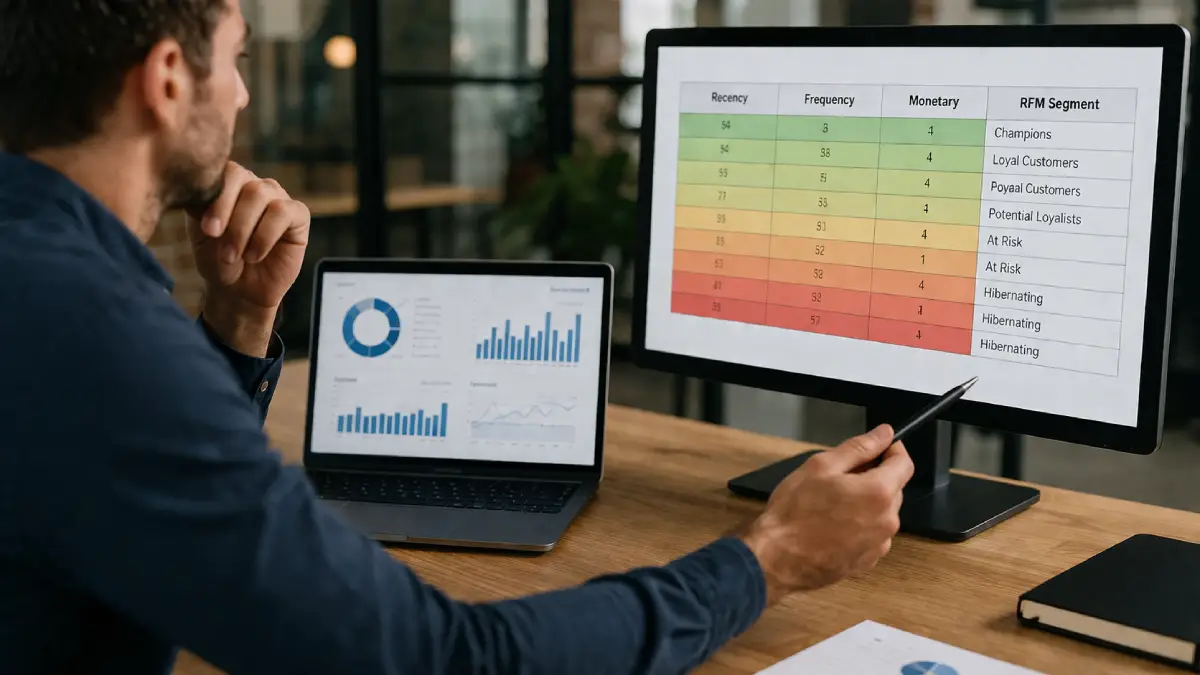
RFM Is Useful. But It Is Not Customer Lifetime Value.
What RFM Measures Well
RFM has lasted in retail for a reason. It is simple. It is practical. It gives teams a fast way to understand customer behavior using three familiar signals: recency, frequency, and monetary value.
- Who bought recently?
- Who buys often?
- Who has spent more?
Those are useful questions. I would not dismiss them. In fact, most retailers would be better off if they used RFM consistently and understood what it was telling them.
Where RFM Starts to Fall Short
The problem arises when RFM is treated as if it answers the broader question of customer value. It does not.
RFM tells the business what the customer has done. CLV helps the business understand what the customer may be worth over time. Those two ideas are related, but they are not the same.
A customer who has purchased recently may not become profitable. A customer who purchases often may depend heavily on discounts. A customer who spends more may also return more, require more service, or generate a weaker margin. A customer who appears quiet today may still have value potential if the right lifecycle, category, or channel strategy is applied.
This is why I think RFM should be respected, but not overextended. RFM is a behavior lens. CLV is a value lens.
What CLV Adds to the Conversation
That distinction matters because many retail customer conversations still start with activity. The most recent buyers, the most frequent buyers, and the highest spenders often receive the most attention. That is understandable. Those customers are visible. They are easy to rank. They make the dashboard feel more actionable. But visibility is not the same as value. Sometimes the most visible customers are also the most expensive to maintain. Sometimes they buy only because the business keeps giving away margin. Sometimes customers who appear less active are actually earlier in the development cycle and warrant a more thoughtful investment.
This is where CLV improves the conversation. CLV forces the business to ask more complete questions. What does this customer contribute after discounts? How likely are they to keep buying? Are they expanding into new categories? Are they becoming more profitable or more expensive over time? Is their behavior stable, improving, or dependent on constant stimulation?
Those questions are harder than RFM. They are also more useful for decision-making.
Why Retailers Need Both
McKinsey’s work on customer lifetime value frames CLV as the identification of valuable customers through targeted investments and the securing of loyalty over time. I like that framing because it moves CLV away from being just a score and toward being a way to decide where customer investment should go. That is the practical point.
- RFM can tell you who looks active. CLV can help you decide whether that activity is worth investing in.
- RFM can help marketing teams target. CLV can help leadership ask whether the business is building durable customer value.
- RFM can support segmentation. CLV can support a customer growth strategy.
- Retailers do not need to abandon RFM. They need to stop asking it to do too much.
- The stronger model uses RFM and CLV together. RFM gives the business a practical language for behavior. CLV gives the business a stronger language for value.
- That combination is where customer intelligence starts to become useful. Not just who bought. Not just who bought recently. Not just who bought often, but who is worth developing, why, and under what economics. That is the better question.
Source note: McKinsey, “Customer lifetime value: The customer compass.”